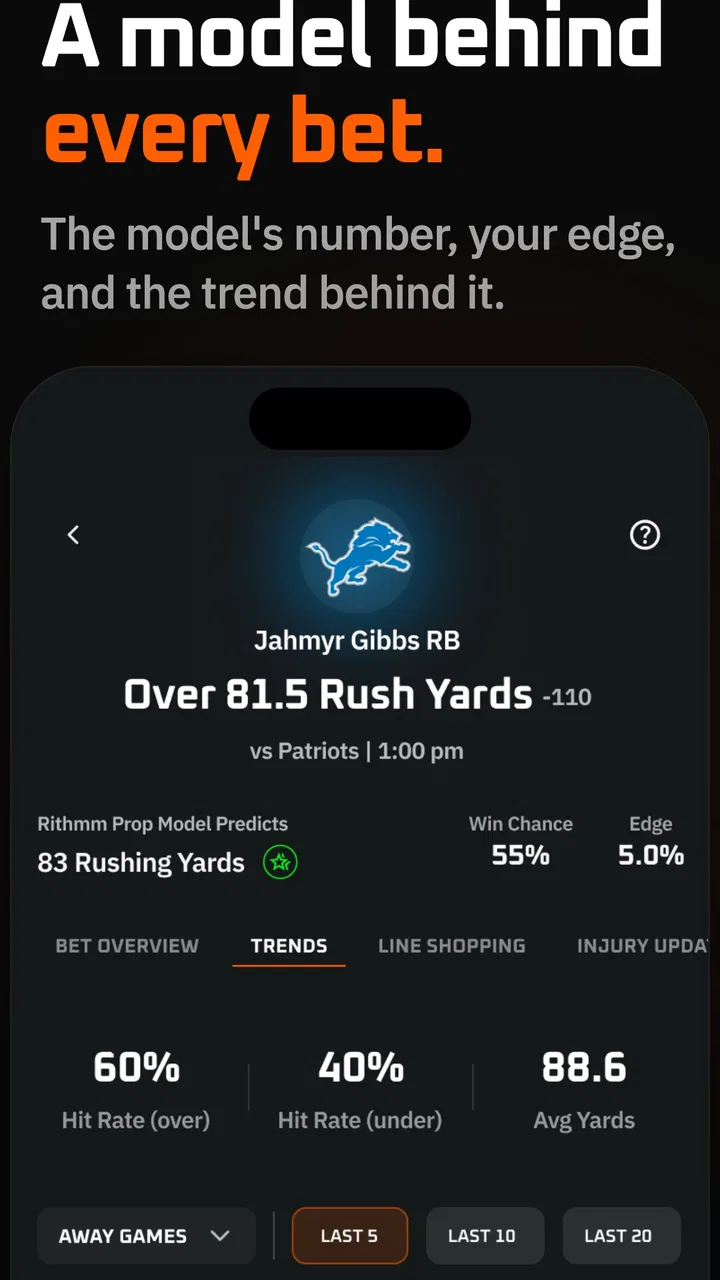
Rithmm: AI Sports Betting
- 4.3
- Rating
- 100.00K
- Installs
- Free
- Price

 Analysis by App-foxy
I approached Rithmm: AI Sports Betting as a sports companion rather than a magic answer machine. Its focus is clear: player props and predictions, presented for people who want more structure before making a betting decision. The app is free to install, comes from Rithmm Inc., and sits in the sports category, but its mature-audience positioning and optional purchases mean it deserves a more careful look than a casual score-tracking app.
My first impression was that the appeal comes from reducing the time spent jumping between names, matchups, and possible prop ideas. Instead of treating every game as a blank page, I could use the app as a starting point for research. That distinction matters. I would not use its predictions as automatic instructions, but I can see why someone who already follows sports betting might enjoy having a focused place to review possibilities.
The app has built a respectable audience, with more than 100 thousand installs and an average rating of 4.3 from roughly 500 ratings. Those figures suggest that the concept works for a meaningful group of users, although they do not turn every prediction into a reliable outcome. Sports are unpredictable, and an app that presents analysis still needs to be judged by how well it fits into a user’s own process.
You May Also Like

 Blood Strike: 2.5 Anniversary
Blood Strike’s Loadouts Turn Every Drop Into a Tactical Gamble
A close look at Blood Strike’s custom loadouts: how fast access to signature weapons reshapes its battle royale rhythm, rewards preparation, and narrows the gap between fights.

 Pandora - Music & Podcasts
Pandora’s Music Is Easy to Start, but Harder to Recover
Pandora’s strength is its low-effort path from a seed to a station. Its weak spot is how much confidence it asks you to place in connection, setup, and quiet recovery.

 8 Ball Pool
 Is Built on Rivalries, Rematches, and Routine
A close look at the rivalries, rematches, shared routines, and unanswered safety questions that turn a quick pool match into a persistent mobile community.

 Samsung Music
’s Quiet Strength Is Playing What You Already Own
Its reach comes less from spectacle than from dependable access to a personal library. That simplicity is both the app’s strongest retention engine and its ceiling.

 AccuWeather: Weather Radar
AccuWeather Review: A Quick, Clear Forecast for Everyday Decisions
For everyday plans, the best forecast is the one you can understand quickly. AccuWeather makes rain timing, radar, and local conditions easy to act on, with a few trade-offs.

 Hill Climb Racing
Why Hill Climb Racing Still Turns Crashes Into One More Run
A tiny car, a bumpy hill and one more upgrade: Hill Climb Racing keeps resurfacing because its simple chaos makes every near-miss feel personal.
More From Our News Desk



How the first week feels
During the first week, the strongest benefit is convenience. A new user can open the app with a specific question in mind, such as whether a player prop deserves further attention, rather than browsing an entire sportsbook without a plan. That makes the experience feel more purposeful than simply scrolling through markets and picking the most familiar name.
I found the most useful mindset was to treat each prediction as a prompt for verification. I would look at the suggested angle, think about the player’s role, and then consider context that an automated recommendation may not fully capture. Is the player’s workload stable? Has the team changed its rotation? Is the matchup likely to alter the player’s opportunities? The app is more valuable when it helps me ask those questions than when I expect it to eliminate them.
That workflow also reveals an important trade-off. The convenience of an AI-assisted prediction can create a false sense of certainty. A polished recommendation may feel more authoritative than a quick personal guess, but presentation is not proof. I would keep a prediction in the “research” column until I had checked the relevant circumstances myself.
The first-week novelty is strongest for users who enjoy comparing several possible props. Rather than locking onto the first option that looks attractive, I could use the app to create a shortlist, then remove ideas that did not fit my own reasoning. This is a better use of the product than opening it only after deciding what to bet, because it gives the app a role in preparation instead of asking it to justify a decision already made.
Another practical tip is to begin with a narrow routine. I would choose one sport or a small set of markets, review the predictions at a consistent time, and record why an option looked interesting before checking the final result. That simple habit helps separate useful process from short-term excitement. Without it, the app can become another stream of tempting possibilities rather than a tool for disciplined evaluation.
What the predictions are good for
The clearest use case is idea generation. If I already follow a league but do not want to manually inspect every player prop, Rithmm can help point my attention toward candidates worth examining. It is especially suitable for someone who likes data-informed discussion but does not want to build a spreadsheet or assemble a research workflow from several unrelated services.
It can also help a user organize a pregame routine. For example, imagine checking the app during a lunch break before an evening game. I might review the available player-focused suggestions, note two or three that seem relevant, and then revisit them later after confirming lineups and other late information. The app saves time at the discovery stage, while the final decision remains mine.
That scenario highlights a limitation that should not be overlooked: a prediction is time-sensitive. A player’s role, availability, or expected workload can change after an analysis is displayed. I would avoid treating an earlier screen as permanently current. Anyone who wants a completely hands-off answer will probably find the experience frustrating, because responsible use still requires attention outside the app.
Rithmm is also not the same as a conventional sportsbook. A sportsbook is built around placing wagers and managing a betting account, while this app’s central value is the prediction and player-prop research layer. That makes it a potentially useful companion, but not a replacement for every service in a bettor’s routine. Users who mainly want scores, schedules, news, or live play-by-play may be better served by a dedicated sports-information app.
Where the free entry point helps
The free price makes experimentation easier. I can test whether the prediction style fits my habits without committing immediately to a subscription-style workflow. That is important because the app’s value depends heavily on personal behavior: someone who checks sports markets occasionally may not receive enough recurring benefit to justify paid extras, while a frequent researcher may find more reason to keep it in regular rotation.
There are in-app purchases ranging from less than a dollar to nearly a thousand dollars per item, so I would pay close attention before confirming any upgrade. The wide range means the free starting point should not be confused with an entirely cost-free long-term experience. I would first use the basic offering long enough to understand whether it improves my decisions, rather than paying because a prediction looks appealing on one particular day.
The app is marked for mature audiences, which fits its connection with sports betting. I would not recommend it as a casual discovery app for younger users or for anyone who has not thought seriously about betting limits. The responsible approach is to separate the cost of using the app from the money involved in wagering and to decide on boundaries before opening a market.
Does it keep earning attention after the novelty?
The month-to-month question is more difficult than the first-week question. New predictions can make the app feel fresh, but recurring value depends on whether it improves a repeatable process. If I open it only to chase the most exciting recommendation, the experience will probably become tiring. If I use it to compare ideas, record my reasoning, and learn where my own judgment is weak, it has a better chance of becoming a useful habit.
I would judge its long-term value by three tests. First, does it help me find relevant player-prop ideas faster? Second, does it encourage better checking rather than impulsive action? Third, does it remain useful when the predictions disagree with my initial opinion? The third test is especially important. A tool that only feels valuable when it confirms me is not helping much.
One non-obvious way to get more from the app is to review misses, not just wins. When a prediction fails, I would ask whether the issue was an unexpected game script, a changed role, a late lineup development, or a misunderstanding on my part. This does not prove whether the model was good or bad from one result, but it turns the app into a learning aid instead of a simple win counter.
I would also avoid measuring the app by a single dramatic outcome. A prediction can look brilliant after one successful result and terrible after one miss, even though neither event explains the whole experience. A calmer monthly review is more useful: Did the app save research time? Did I make fewer rushed choices? Did I understand why I selected a prop? Those questions measure recurring value without pretending that sports outcomes are predictable in a perfect way.
For a dedicated sports bettor, that routine may justify keeping the app installed. For a casual fan who rarely considers player props, the value may fade quickly once the initial curiosity disappears. The product has a specific purpose, and its usefulness is tied to how often that purpose naturally appears in a user’s life.
The maintenance burden behind the convenience
Rithmm reduces some research effort, but it does not remove maintenance entirely. I still need to check whether the information is relevant to the current situation, understand what market is being discussed, and avoid confusing a model-generated suggestion with a guarantee. That mental work is not a flaw unique to this app; it is simply the price of using predictions responsibly.
The most efficient routine would be short and deliberate. I would open the app when I am genuinely researching a game, inspect a limited number of ideas, verify the context elsewhere, and then close it. I would not keep refreshing throughout the day just because new possibilities might appear. Constant checking can turn a useful research tool into a source of distraction and emotional pressure.
Another maintenance issue is personal record-keeping. If I want to know whether the app is helping me over time, I need some way to remember what I considered and why. That can be as simple as a note containing the player, the reason for interest, and what changed before the event. Without that record, memory tends to preserve exciting wins and forget ordinary misses, making the app seem more effective or less effective than it really is.
This is where Rithmm differs from a fully automated service. It gives me a focused prediction experience, but I remain responsible for interpreting it. Users who prefer a simple score app with no financial decision attached will find this burden unnecessary. Users who already enjoy analysis may see it as a reasonable exchange for faster idea discovery.
Why fatigue can set in
The main source of fatigue is repetition. Player props can look different from one game to the next, but the basic cycle remains similar: inspect a suggestion, assess the context, decide whether it deserves attention, and wait for the result. If the user expects constant novelty, that cycle may become monotonous.
There is also emotional fatigue. Predictions can encourage users to keep searching after a disappointing result, hoping the next option will repair the previous one. I would be cautious about opening the app immediately after a loss. A short pause is often more valuable than another recommendation, especially when the goal has shifted from research to recovery.
The purchase structure may add another layer of pressure for some people. Because optional items can reach a very high price, I would not explore paid features casually or assume that a more expensive option automatically offers better judgment. The sensible approach is to decide what the app is worth to me in advance and stop if the cost no longer matches the practical benefit.
Fatigue can also come from information overload. A long list of possible props is not automatically better than a short list. I would limit myself to ideas connected to games I actually follow and reject options that I cannot explain in plain language. If I cannot say why a player’s opportunity might change, I probably do not understand the selection well enough to use it.
For those reasons, I would not recommend keeping notifications or frequent checks at the center of a daily routine unless the user already has strong boundaries. The app works better as a scheduled research stop than as a constant companion competing for attention.
Who should use it, and who should skip it?
I think Rithmm is best for an adult sports fan who already understands the basics of betting, enjoys player props, and wants help narrowing the research field. It can be particularly useful for someone who has enough interest to compare predictions but not enough time or technical confidence to create a personal analysis system from scratch.
I would also recommend it to users who are comfortable being challenged. The app is more useful when its suggestions are treated as hypotheses. If a prediction conflicts with my view, I can investigate the difference and decide whether my assumptions are outdated. That makes the product more educational and less dependent on blind trust.
I would skip it if I mainly want live scores, team news, fantasy management, or a straightforward place to place bets. Those needs belong to other types of sports apps. I would also skip it if I am looking for certainty, guaranteed profit, or a way to make decisions without learning anything about the players and games involved. No prediction interface can replace judgment, and this one should not be used as an excuse to ignore personal limits.
Device compatibility is reasonably broad because the app requires Android 7.0 or later. The current release is version 3.4.11, so users on supported Android devices can approach it as a current, actively maintained tool rather than an abandoned experiment. Still, the practical question is not simply whether it runs; it is whether the user’s sports habits create enough repeated need for its focused purpose.
My long-term verdict
After the first-week appeal fades, Rithmm: AI Sports Betting earns its place only when it becomes part of a controlled research habit. Its strongest contribution is not the promise of being right every time. It is the ability to give player-prop research a clearer starting point, especially for users who otherwise spend too much time browsing without a consistent method.
I like the app most when I use it to generate questions, compare possibilities, and review my reasoning later. I like it least when the prediction screen starts to feel like an instruction or when I keep checking for another option after an unwanted result. That difference comes down to user discipline, but the design of a prediction-focused product makes the distinction especially important.
The free entry point makes it worth testing, while the mature rating and broad in-app purchase range are good reasons to proceed carefully. I would not pay for extras until I had established that the app saves me meaningful time over several ordinary sessions, not just one exciting slate. If the free experience does not improve my process, spending more is unlikely to solve the underlying problem.
My recommendation is therefore selective rather than universal. For an adult who follows player props and wants an AI-assisted research companion, it is worth trying. For a casual sports viewer, a score-and-news app will probably offer more lasting value with less mental overhead. The lasting benefit comes from better habits around predictions, not from treating predictions as certainty.
In the end, I would keep it installed if I were actively researching player markets and willing to verify its suggestions with my own judgment. I would remove it if it became a source of constant checking, impulsive decisions, or unnecessary spending. Used with boundaries, it has a practical role; used as a shortcut to guaranteed answers, it is the wrong tool.
FAQs for Rithmm: AI Sports Betting
01What is Rithmm: AI Sports Betting, and how does it work?
Rithmm is a sports analytics and betting research app that uses statistical models and artificial intelligence to evaluate games, player information, trends, and available betting lines. Instead of guaranteeing winners, it presents data-driven predictions, suggested bets, confidence indicators, and supporting statistics to help users make more informed decisions. The app is best viewed as a research and analysis tool, not as a replacement for personal judgment or responsible bankroll management.
02Which sports and betting markets are supported in Rithmm?
The sports and markets available in Rithmm can vary depending on the current version of the app, your location, the league calendar, and sportsbook data coverage. Users may find analysis for popular leagues and markets such as moneylines, spreads, totals, player props, or other betting options. Before downloading, check the app’s current store description and in-app coverage, especially if you follow a specific sport, league, or regional competition.
03Can Rithmm guarantee winning bets or make betting risk-free?
No. Rithmm cannot guarantee winning bets, and no legitimate sports prediction app can eliminate uncertainty. Its models are based on historical data, statistical probabilities, and available information, but injuries, line changes, unexpected performances, weather, and other factors can affect results. Predictions should be treated as opinions supported by data. Only wager money you can afford to lose, set limits in advance, and avoid chasing losses.
04Does Rithmm place bets automatically, or do I need a sportsbook account?
Rithmm is primarily designed to provide predictions, analysis, and betting insights rather than automatically placing wagers for you. In most cases, users review the recommendations and then decide whether to use a separate licensed sportsbook. Availability and integrations may depend on your country, state, or region. You should verify local betting laws, confirm that any linked operator is legal where you live, and review all odds before placing a bet.
05Is Rithmm free to download, and what should I know about subscriptions?
Rithmm may be available to download for free while offering premium features through subscriptions, in-app purchases, or different membership plans. The exact pricing, trial terms, model access, and cancellation rules can change, so read the current App Store or Google Play listing and the checkout screen carefully. If you start a trial, check its renewal date and manage cancellation through your Apple or Google account settings.
Pros
- AI-generated picks are organized by sport
- matchup
- and betting market.
- Useful probability and value indicators help compare bets more objectively.
- The app can save time researching statistics across multiple games.
- Personalized bet feeds make it easier to follow preferred teams and sports.
- Clean presentation makes complex betting data relatively easy to understand.
Cons
- AI predictions are not guarantees and can still lose consistently.
- Some advanced insights may require a paid subscription or premium plan.
- Coverage and pick quality may vary between sports and betting markets.
- Odds can change after a recommendation is generated or displayed.
- The app may encourage frequent betting and requires responsible bankroll management.

Rithmm: AI Sports Betting
Gallery